Benjamin states that in opposition to the additive method of historicism, his “materialist historiography … is based on a constructive principle” (SW 4:396). Instead of tracking the course of progress through an empty time, Benjamin proposes a new method based on gathering up the traces of the past and allowing them to display themselves in their fullness. It is not the case that “what is past casts its light on what is present, or what is present casts its light on what is past”; “rather,” Benjamin tells us, “image is that wherein what has been comes together in a flash with the now to form a constellation.” Put simply, “image is dialectics at a standstill” (AP [N3,1]). The image is a construction within the moment. As each moment is spoken for in that the thought eternal recurrence makes each moment full of all other moments, images constructed within it can show things that happened in the past. This forms a constellation, in which the linkages to these past events become visible. In an astronomical sense, the formation of a new constellation does not necessarily mean the creation of new stars; the stars are always there, the constellations are merely ways of grouping and viewing the stars. Furthermore, considered in terms of a constantly expanding universe, these constellations themselves are always in flux, as the stars are not in a fixed point within space. A constellation is in entirely dependent on perspective. This is why the image is “dialectics at a standstill”: in a universe of becoming, in a dialectic which is constantly in motion, the image only attains visibility as a construction within the moment of the moment. Benjamin speaks of the dialectical image flashing up in the moment, “in the now of its recognizability”, but “in the next moment [it] is already irretrievably lost” (AP [N9,7]). By the time this moment has passed, the cosmos has shifted and the constellation has taken on a different form. The disintegration of the aura means the opening of the borders of the artwork, leaving it open to different interpretations at each point. However, this also means that each interpretation only attains to intelligibility within its moment of origination. Benjamin informs us that his methodology necessitates “the notion of a present which is not in transition, but in which time takes a stand and has come to a standstill” (SW 4:396). This does not contradict the notion of a universe of becoming, but rather, this means that the moment exists as an instance of this becoming. The present freezes in its instantiation and then turns into the past. Thus, the dialectical image becomes the image of the moment, capturing it as a moment of arrest. In as much as it is the still image of a passing moment, the dialectical image can be understood, as Eduardo Cadava argues in his book, in terms of a photographic image and its relation to history. The photographic instant takes up the moment of its instantiation; by the time the photograph has been taken, the moment has already passed. Benjamin’s “Little History of Photography” was written in regards to early photographic techniques that required great amounts of time, but the same concept holds true even for the most instantaneous methods of photographic imaging. Even the digital camera, while producing the freshest, most recent image, is still only capable of capturing an image of something that has passed. Thus, the construction of the dialectical image becomes an instantaneous process in which the present is “arrested” in its transition to the past. This arrest is made possible via a process of affirmation of eternal recurrence.
Benjamin cites the following passage on eternal recurrence from Nietzsche in The Arcades Project: “the great thought as a Medusa head: all features of the world become motionless, a frozen death throe” (AP [D8,6]). Eternal recurrence becomes a photographic apparatus, freezing the world at all points. Via affirmation, we are able to construct these images of history. As Eduardo Cadava writes, “for Benjamin, there can be no history without the Medusa effect – without the capacity to arrest or to immobilize historical movement, to isolate the detail of an event from the continuum of history.” This arrest freezes the moment as a moment, and gives the historian space to wrest it from its placement in progressive of history. Benjamin speaks of the goal of historian as “[blasting] open the continuum of history” (SW 4:396). There is no continuum of history; the destruction of the continuum is much like the disintegration of the aura. It is not so much that it is destroyed, as it is shown never to really have existed at all. That is to say, history existed, but it existed as an artificial construction of man. It seems contradictory to say that affirmation is linked to the destruction of this construction. If history appears to us as a continuum, would transvaluation not dictate that this appearance be the way things really are? The thrust of Benjamin’s argument here is to show that the continuity of history is merely the “persistence of [the] semblance of persistence” (AP [N19,1]). As we have seen with the aura, things are not always appear, and the object of affirmation is to strip these things down to see what they really are.
“‘Construction’ presupposes ‘destruction’”, Benjamin writes; the Dionysian affirmation is two-fold, taking joy in both (WP §1049). Transvaluation consists of the destruction of old values in the construction of new ones. As such, the Dionysian affirmation must also contain a negation. In order to affirm the “world as it is”, it is absolutely necessary to deny the world as it is not. This is the nature of the destructive forces of construction. Fascism, history, and the aura are false becomings, presentations of the world as it is not. Dionysian affirmation is a critical tool, calling all of existence into crisis. On the other hand, simple affirmation, as the affirmation of what is, then things never leave the status quo, and we are bound to an eternity of catastrophe. This is the affirmation of Zarathustra’s ass, who “does not speak, except always to say Yea to the world he created” (Z, 322). Blind affirmation leads the affirmer to follow just about anything, just like Zarathustra’s guests. Fascism purports itself as a historical norm, but there is no criticality to its affirmation; it represents a mere revaluation. In order to break free of historicism, it becomes necessary to destroy the need for historical continuity; we must destroy in such a way that “continuity” is no longer meaningful. Transvaluation demands a negation, but as Nietzsche tells us, “it does not halt at a negation, a no, a will to negation” (WP §1041). It is not enough to understand it simply in terms of the idea that “extreme positions are not succeeded by moderate ones, but by extreme positions of the opposite kind” (WP §55). That it is one way of looking at it, but it does not go far enough. Revaluation is a product of reactive forces, clinging to the old elements of valuation. Transvaluation, the transmutation of values, means a qualitative shift in the value giving element. It is a transformation of the destructive into the creative, the act of destruction into an affirmation. As Deleuze explains, “the will to nothingness is converted and crosses over to the side of affirmation, it is related to a power of affirming.” Affirmation now has a double-action: the affirmation of what is also entails a simultaneous refusal and destruction of what is not. This is why in place of the continuum, Benjamin offers up the idea of the constellation. The Medusa-action of eternal recurrence freezes existence, and allows us to pluck the elements out to form the constellation. As Benjamin writes in the notes to the Theses, “articulating the past historically means recognizing those elements of the past which come together in the constellation of a single moment” (SW 4:403). The constellation is formed via a process similar to the transformation of will described above. The arrest of time via eternal recurrence freezes of the moment within the image – “dialectics at a standstill” – allowing all the dialectical tensions are seen for what they are: the positive and negative elements. What Benjamin proposes is a shift in perspective, in which all the negative elements are seen in a positive light, in such a way that “a positive element emerges anew” (AP [N1a,3]). Considered in terms of affirmation, the negative is affirmed in its status as the negative side of the dialectic. By placing things into the constellation, their relative position and status is affirmed as well; it is not a haphazard construction. Those things that are outside becoming, these false constructions, are rejected, and are thus affirmed in their exclusion from the constellation. As such, these false becomings are transformed, “ad infinitum, until the entire past is brought into the present in a historical apocatastasis” (AP [N1a,3]).
Tuesday, 23 September 2008

Friday, 19 September 2008
the untenability of history
The first step in the transvaluation of history entails the destruction of the old forms of history, which is accomplished via the “most nihilistic thought”, eternal recurrence. Benjamin tells us that “in the idea of eternal recurrence, the historicism of the nineteenth century capsizes” (AP [D8a,2]). This form of historicism is based on much of the same values as the old forms of aesthetics, that is to say, of the historical object having a unique existence in space and time. In the last chapter, it was shown how, given the thought of eternal recurrence as a form of mass production, even unique art objects become mere recurrent reproductions. Eternal recurrence means that in order for a thing to be, it has to recur. As such, everything that is now has already been. This understanding now forces itself on the past, in that it transforms “even the historical event into a mass-produced item” (AP [J62a,2]). As a mass produced item, the historical event can hold no claims to a unique existence; from the point of view of recurrence, the Paris commune is no longer “the” Paris commune, but rather “a” Paris commune. The result of this thought, Benjamin tells us, is that “every tradition, even the most recent, becomes the legacy of something that has already run its course in the immemorial night of the ages” (AP [D8a,2]).
Another aspect of historicism which crumbles under the thought of eternal recurrence is progress. Progress is little more than the ossification of history into a fixed narrative, closing the borders of the past at all points. For Benjamin, there is no such thing as progress. Becoming wants nothing and aims at nothing, and as such it tends only towards itself. The most nihilistic thought attacks the notion of progress, as Eduardo Cadava writes, “within a cosmic process of repetition, the notion of progress belongs to the domain of phantasmagoria.” Given the knowledge of recurrence, belief in any notion of progress seems incredibly foolish; eternal recurrence brings the untenability of traditional history to the fore, exposing it for what it is. Progress implies movement towards something, towards a definite endpoint; it implies improvement. For Benjamin, this manifests itself, via the vulgar-Marxist conception, as the transformation of history into a natural science. History tries to follow the same rules as science, looking for laws and truths with which to claim some authority on the past. This is precisely what Nietzsche is referring to when he critiques the pursuit of historical knowledge. Historical truths and norms are impossible because “[the world] is ‘in flux,’ as something in a state of becoming, as a falsehood always changing but never getting near the truth: for – there is no ‘truth’” (WP §616). Becoming evades all laws and truths, and as such, progress can never approach anything other than becoming itself.
The notion of progress is extremely dangerous for Benjamin, as it is in its name that the opponents of fascism accept its emergence as a “historical norm” (SW 4:392). There is no such thing as historical norms; they are solely the invention of man, forcing some kind of order onto the past. In thesis IX, Benjamin refers to progress as storm which prevents history from righting itself. The angel of history is caught in the wings of progress, helpless to repair the catastrophe of human history as he is ceaselessly blown away. Progress is inherently tied to the status quo; in fact, it creates the status quo. “That things are ‘status quo’,” writes Benjamin, “is the catastrophe” (AP [N9a,1]). Progress refuses to let things be, trying to organize history in to norms, laws and narratives. As such, it subverts human activity: “nothing so corrupted the German working class as the nothing that it was moving with the current” (SW 4:393). The problem lies in that there is no “current” in becoming, it just flows. It moves and unfolds, but it has no ends other than itself. This belief in progress amounts to little more than petty fatalism, pushing towards the inevitable end of the linear course of history, whether it be the victory of fascism or the utopia of the proletariat (SW 4:394). It is precisely this conception of progress that causes the worker to sacrifice his revolutionary potential, as it presents fealty to progress as inherently revolutionary. This conception is impossible, there is no such thing as the end of the course of history (for becoming has no aim). The closest thing to the end of history is the perspective afforded us via the thought of eternal recurrence, which is that existence never ends, it just recurs. The idea of progress crumbles, and “the idea that history is something that can be narrated” dies with it (SW 4:406).
There is a unifying core principle that underlies the various manifestations of progress: “the concept of [mankind’s] progression through a homogenous, empty time.” Benjamin argues that “a critique of the concept of such a progression must underlie any critique of the concept of progress itself” (SW 4:395). Progress relies on the openness of the future, the endless extension of existence; it needs space to operate. Even those conceptions of progress which approach something – revolution, utopia, et cetera – are reliant upon a concept of time as an empty space across which it can march on its way towards destiny. However, in the realm of eternal recurrence, time is always already spoken for. Nietzsche writes that time is eternal, and the changes within time – that is to say history and becoming – are merely how we experience it. Repetition simply reveals to us the fact “that it has always happened thus” (WP §545). This is not to say that Benjamin rejects progress in favor of a fatalistic conception of history, for fatalism means nothing if we do not know what was fated beforehand. The only end – fated or otherwise – towards which existence tends is recurrence. The affirmation of eternal recurrence negates fatalism, turning it into an act of creation. At the same time, Benjamin tells us that instead of empty time, we should see the history as a construction within “time filled full by now-time” (SW 4:395). Now-time is a tool with which the continuity of the discourse of historical progress can be broken, in that it is used to link the present to moments in the past. Now-time as recurrent time means that progress can no longer attain to its narrative of causality, for within eternal recurrence, the motor of existence is “no longer cause and effect” (WP §1059). The eternal repetition of the interaction of forces removes cause and effect, as each element of the cycle conditions all other. Eternal recurrence provides us with a sequence of events, but it does not mean that they necessarily cause each other. Nietzsche explains that “the feeling that post hoc is propter hoc can easily be shown to be a misunderstanding”; rather, the cycle “is comprehensive” (WP §545).
This is not to say that Benjamin – or Nietzsche for that matter – is annihilating history. The Dionysian process means that the old forms of historicism are destroyed in order to make way for a new creation of history. The additive process of historical progress, the accumulation of “a mass of data to fill the homogenous, empty time” (SW 4:396), can never approach becoming, for becoming itself is a process of this destructive regeneration. As such, the new form of historiography must take this maxim into account: “the relationship of what has been to the now is dialectical: is not a progression but image, suddenly emergent” (AP [N2a,3]). The activity of history is now solely concerned with the undertaking of the construction of images.
Tuesday, 16 September 2008
political view of the past
One of the most famous usages of Nietzsche in Benjamin’s oeuvre appears in the History essay:
“We need history, but our need for it differs from that of the jaded idlers in the garden of knowledge” (SW 4:395). This comes from Nietzsche’s essay “On the Uses and Disadvantages of History for Life.” The passage there continues on, saying, “we need it, that is to say, for the sake of life and action. … We want to serve history to the extent that history serves life” (H, 59). Here, Nietzsche prefigures what effects transvaluation might have on history. As we discussed earlier, the problem comes when we choose to evaluate something transitory – as art and history are merely material manifestations of becoming – in terms of something constant. The central problem with history as an academic discipline, as Nietzsche sees it, is that in the name of knowledge, it turns away from living. This is very similar to the problem he has with most academic pursuits: they tend to valuate the valueless – that is to say, the things beyond the realm of value. Becoming has no value; it lacks anything against which to measure it. Man’s fatal error is that he does not see this: “the aberration of philosophy is that, instead of seeing in logic and the categories of reason means toward the adjustment of the world towards utilitarian ends … one believed one possessed in them the criterion of truth and reality” (WP §584). The creation of a true or real world is an act of treason against this one. For both Nietzsche and Benjamin, traditional history is the practice of constructing a “real” or “true” world in the past. But we do not want the real world. If we have abolished the real world – and hence the apparent one – in the present, then it no longer holds true in the past either. Thus, as Benjamin says, the task of the historian does not entail “recognizing [the past] ‘the way it really was’” (SW 4:391). The way things “really were” no longer has any meaning, as the distinction is unintelligible. The issue at stake in history is the same as in aesthetics. Traditional history is the application of stagnant categories of value onto the past: “historicism offers the ‘eternal’ image of the past.” However, what Benjamin, after Nietzsche, is offering is “unique experience with the past” (SW 4:396). History becomes political in that its valuation is no longer tied to any categories other than the categories of becoming. Thus, rather than an evaluation of history, historical materialism translates into an experience of becoming, “[blasting] as specific life out of the era” (SW 4:396).
It is absolutely essential to this conception of history to appropriately understand becoming. Nietzsche equates becoming to living because that is the way humans experience becoming; it is so phrased in opposition to stagnation and “being”. This is not to say, however, that becoming has any vested interest in human life. “Life is a unique case,” Nietzsche says in The Will to Power. “One must justify all existence and not only life – the justifying principle is one that explains life, too” (WP §706). As we discussed earlier, eternal recurrence is dependent on the fact that becoming aims at nothing. It has no master plans, no end. It is nothing more than the unfolding of a series of interactions. Benjamin offers a citation to similar ends in Thesis XVIII of “On the Concept of History”:
'In relation to the history of all life on earth,' writes a modern biologist, 'the paltry fifty-millennia history of homo sapiens equates to something like two seconds at the close of a twenty-four hour day. On this scale, the history of civilized mankind would take up one-fifth of the last second of the last hour.' (SW 4:396)
The idea here is a sort of a non-anthropomorphic, non-anthropocentric concept of the universe, in as much as the past has always existed but humans have not. In other words, the past is everything that has previously happened; history is just human understanding of the past. History, as it is a concept, is entirely a construct of human thought. The problem, as Nietzsche and Benjamin diagnose, arises in as much as people forget the constructed nature of history. Forgetting in and of itself does not constitute a problem, as it can play an essential part in affirmation. However, disregarding the nature of history leads to its ossification as the cult of history. Much like what happens in non-political aesthetics, we create a theory of valuation in opposition to life. Forgetting its origin, it claims to be the only valuation, denying all change and fluctuations. History, like the artwork, is a product of becoming, and as such, its borders must be open.
Transvaluation affects a re-orienting of history, “by dint of a secret heliotropism” (SW 4:390); the center of the historical universe is no longer knowledge but rather becoming. The old categories of history referred back to purely fictitious values. There is much still at stake here for Benjamin. Fascism’s power is not just in aesthetics, but in history as well, turning the past into a historical narrative and ossifying it into the story of the fatherland’s inevitable victory. Thus, Benjamin again attempts to present theories that are useless to fascism in that they expose fascism’s inherent fictions. He writes: “The current amazement that the things we are experiencing are ‘still’ possible in the twentieth century is not philosophical. This amazement is not the beginning of knowledge – unless it is the knowledge that the view of history which gives rise to it is untenable” (SW 4:392). Once again, Benjamin presents us with a choice: recognize the transitory nature of history and affirm it for what is, or deny becoming and buy into the grand narratives of fascism.
Saturday, 13 September 2008
becoming-political of aesthetics
The transvaluation of aesthetics places the value giving judgment in the political. The loss of aura is an emancipatory act. Aesthetics inherently becomes political. Aesthetic experience becomes political experience. This is slightly different than say Kant or Schiller, in whom the aesthetic experience lays the ground work for politics. Schiller, for example, feels the free play provided by an experience of the beautiful is what prepares man for politics. Benjamin differs, in that for him, aesthetic experience is the political. The exhibition value of an artwork is a measure of it political affectivity. Technology enhances is this, in that it creates new exhibition spaces, reaching masses and affecting more people in ways previous mediums could not. For Benjamin, the art is valued on it political basis, and as such, and experience of the beautiful is an inherently political experience. Art effects the organization of masses. One example Benjamin gives of this is the formation of habits. Habituation is an example of the way in which the medium of art creates a political grouping by its ability to “mobilize the masses” (SW 4:269). The ability of art to form politicized masses means that “to theorize and make recommendations for artistic practice is also to make theoretical recommendations for political practice.” However, the interrelation of aesthetics and politics is not an unqualified good for Benjamin. Once again, it comes down to a choice between affirmation and denial. In one of the most famous passages of the artwork essay, Benjamin tells us that the interrelation can take two forms: the aestheticization of the political characteristic of fascism; or the politicization of aesthetics as performed by communism.
Aestheticizing the political is what happens when we merely revaluate. It is a reaction against the changes of becoming. What Benjamin means by the “aestheticizing of political life” is that values become stagnated and turn back in on the political. Instead of aesthetics being evaluated in terms of becoming, becoming is now evaluated in terms of the old aesthetic values. It is an essentially reactive maneuver, “[responding] to the changes in perception wrought by new technologies.” In his “Theories of German Fascism”, Benjamin says the fascists relate to technology as “a fetish of doom” in that they cannot see the way in which it is constitutive of experience (SW 2:321). As Nietzsche reminds us, there is no value suitable for the evaluation of becoming, and this “fetish of doom” as it falls under “philosophical pessimism”, it “ranks among comical things” (WP §708).
As comical as it may have been for Nietzsche, fascism carried far more gravity for Benjamin. The problem is not that fascism merely is anti-technology. In fact, the fascists were highly technological. They mechanized warfare and industrialization to a degree never before seen; the Nazi war machine was previously unparalleled in human history. The true danger is that fascism utilizes technology, but it only does so in an unnatural manner. In terms of artistic production, instead of liquidating the aura in the wake of reproduction, fascism resurrects ritualistic values in order to subjugate reproduction. “Ahistorically insisting on its eternal features,” Esther Leslie notes, “fascist art and politics demonstrate the re-entry of cult values” into modern production. This is part of the power of fascism. Ritual values were always based on the unique existence of the artwork. These were called into question by reproduction, which is able to produce seemingly infinite copies. Rather than finding these objects bereft of aura, it applies the same categories of authenticity to these reproductions. Technological reproduction becomes a miraculating machine, endlessly creating magical copies. Thus, a print of a photograph of Hitler becomes a religious icon and a mass-produced swastika becomes a sacred standard. By reintroducing the aura, fascism becomes capable of instilling any object with a sacred power. At the opening of the essay, Benjamin asserts that his ideas are “completely useless for the purpose of fascism” (SW 4:252). This is accomplished, in as much as the liquidation of the aura can be seen as an exposition of false basis from which fascism draws its power. If we can see the other world to be false, then fascism appears to us stripped of its veil, laid bare in its false creations.
If the aestheticization of politics is understood as the stagnation of the political via old aesthetic values, then the politicization of aesthetics can be understood as the emancipation of aesthetics via the political. As we described in the above section on transvaluation, aesthetics is opened up in a continuous process of transvaluation. As opposed to the denial of becoming characteristic of fascism, “communism, for Benjamin, affirms the flux of identity and the permanent revolution of the organization of experience.” Communism represents the possibility of change and a different relationship to technology. In opposition to the fascistic “fetish of doom”, communism sees technology as “a key to happiness” (SW 2:321). (Insert note about communist utopias as the space in which technology is put towards human ends. I remember reading somewhere someone talking about this. But I’ve been pouring over my notes and I can’t seem to find it. So, I’m just leaving it for the time being until I can remember where I read it.)
There is no middle ground for Benjamin in this debate. The difference between the two, between fascist domination and communist utopia, comes down to a simple choice. Esther Leslie phrases it in no uncertain terms: “the crisis must culminate in either the rejuvenation of humanity, marked my humanity’s adoption of a political relation to art, or its complete destruction, signaled by an aestheticization of politics.” The stakes are dire, as Benjamin new all too well. It is not possible to do nothing. Fascism thrives on the passive assent of a reactive nihilism. The only way to counter this is through the creatively destructive affirmation of an active nihilism.
call for re/transvaluation
The old aesthetic values fall into what Nietzsche speaks of as “higher values.” Authenticity and uniqueness are called into crisis (via reproduction) and are shown to be “categories that refer to a purely fictitious world” (WP §12b). But it is not enough to stop here, with the death of aura. A nihilism that merely destroys the old values constitutes a weak, reactive nihilism. It is like a petulant child, denying anything put in front of it. “If the tyranny of former values is broken in this way”, Nietzsche writes, “then a new order of values must follow of its own accord” (WP §461). Creation and destruction are inextricably linked within the Dionysian affirmation. Creation is only possible via destruction. In his description of the Nietzschean operation within Deleuze’s philosophy, Peter Hallward says, “an active or masterful force is one that creates values rather than extinguishes them.” This is slightly misleading, for it implies that the extinguishing of values is outside the creative realm. A more accurate statement would be: “an active force is one that creates values as it extinguishes them.” The only complete nihilism for Nietzsche is one that overcomes itself.
It is not enough to say “that nothing formerly held true is true” (WP §459). Nihilism demands more than just a new set of rules. Art has changed its rules before. Even when the explicitly religious valuations were discarded, the same structures of value led to the secularized “cult of beauty” (SW 4:256). The task Benjamin accomplishes in this work is the exposition of all these various forms of valuation as having the same basis: ritual, which in turn is based on uniqueness and authenticity. In order to achieve true change in the theory of art, the concept of aura must be liquidated, for, as Deleuze states, “it is only by changing the element of values that the values that depend on the old element are destroyed.” It is a weak nihilism that engages in mere revaluation, attacking the symptoms of values but not the underlying disease. Active nihilism, on the other hand, culminates in transvaluation: “not a change of values, not an abstract transposition … but a change and reversal in the element from which the value of values derives.” However, in order for this to truly be the completed form of nihilism, the element of value has to be that which itself constitutes change. For Nietzsche, that element is becoming: “becoming has no value at all, for anything against which to measure it, and in relation to which the ‘value’ would have meaning, is lacking” (WP §708). There is no standard by which to judge becoming, nothing to compare it to. It can form the element of valuation, though, in that things can be judged by their relation to becoming. That is to say, to what degree does it facilitate or deny becoming. In this way, transvaluation achieves an overcoming of nihilism, in that it turns nihilism itself into constant transvaluation.
Benjamin says that once emancipated from the strictures of the rule of aura, art finds a new social function: “Instead of being founded on ritual, it is based on a different practice: politics” (SW 4:257). Politics serves as the new element of valuation for art. Like becoming, politics is beyond value in and of itself. There is no measure to which we can judge politics. There are ways of judging political formations and organizations, but these are not evaluations of politics as such. Whereas before, basing value in terms of ritual, artworks’ use-value was cultic. Cultic value represents the values of inaccessibility, of higher values. But the affirmation of their demise leads to something different, for “to affirm is to unburden: not to load life with the weight of higher values, but to create new values which are those of life, which make life light and active.” The political valuation links politics to becoming, that is to say, to life itself. The use-value facilitated by political valuation of art is what Benjamin terms “exhibition value.” The exhibition value is related to politics in that it is derived from the way it associates becoming and living to the work. This of course, changes the functions of art, and leads to “a qualitative transformation in its nature” (SW 4:257).
One of these transformations, Benjamin tells us, is that “the artistic function may subsequently be seen as incidental” (SW 4:257). The political valuation of art certainly changes the value of artistic function, but we misread Benjamin if we see this as a negation of artistry. That would be to misunderstand the nature of the change in values. A properly nihilistic transvaluation means that no destruction goes unaccompanied by a new creation. In The Disenchantment of Art, Rochlitz writes: “the technically reproducible work of art, as Benjamin had described it, no longer contained any properly artistic value; desacralization has left in its wake only instrumental and therapeutic functions.” It is true that Benjamin does not account for a “properly artistic value”, but those artistic values were based in the old system of valuation. In the wake of transvaluation, artistry, too, must be rethought. “Art as was can no longer be in the face of reproduction,” says Esther Leslie, “and artistry moves from isolated and unique production to a sort of scientific production in front of a number of production experts.” That is to say, that the death of traditional art means the death of traditional artistry. Technological reproduction creates new forms of art, forms that are reproduced by virtue of their very production. Film, for example, presents itself as a form which can be exhibited in ways never before possible for traditional forms. If art is to be judged on its political basis, than artistry becomes a measure to which the political value is effectuated within the exhibition of the work. Granted, as Benjamin states, artistry does become increasingly incidental. This is due to the fact much of this effectuation occurs via the reproductive process. Still, it is up to the artist to produce works that facilitate this process to a certain degree of success. Furthermore, the artist himself takes a completely different role, as the effect of exhibition takes precedence over the effect of the artist. The artwork is no longer dependent on its status as created by an artist for its value. Still, this is not to say that artistry is dead, but that it has merely been transmuted.
But it is not just artistry that is transformed in this new relation. The nature of experience finds itself in crisis. Benjamin tells us that the “The crisis of artistic reproduction that emerges in this way can be seen as an integral part of a crisis of perception itself” (SW 4:338). Or, put another way, “the issue of what constitutes a work of art is symptomatic of the broader question of how to respond to the change in the character of experience provoked by technological progress.” Our ways of perception, our experience of the artwork were based on a certain type of experience. For example, in Kantian aesthetics, the aesthetic judgment “cannot be other than subjective.” That is to say, it has to be based on what “the subject feels himself, [namely] how he is affected” by the artwork. The beautiful was derived as a use-value from the effect. This experience is based around the old experience of the artwork, a reflection on a unique object in a unique space and time. The beautiful takes a different role in the realm of mechanical reproducibility. The nature of the reflection changes, as “technology has subjected the human sensorium to a complex kind of training” (SW 4:328). The feeling of pleasure is based around the political exhibition value of the object of reproduction. The beautiful in the classic sense no longer applies. Rather, beauty must now be conceived as a qualification of the politicality of the work. This change in the relation of experience is embodied by Baudelaire: “He named the price for which the sensation of modernity could be had: the disintegration of the aura in immediate shock experience. He paid dearly for consenting to this disintegration – but it is the law of his poetry” (SW 4:343).
Let us consider this in another way. Benjamin defines the aura of natural objects as “the unique apparition of distance, however near it may be” (SW 4:255). The power of the auratic lies in its unattainability. When applied to art objects, it means that no matter how close one gets to the object, it can never get grasp the source of its power. The apparition of distance means that the true distance to the source of the aura is an illusion. It can never be fully grasped; one cannot touch a ghost. This is to say that there is something outside of experience. Or rather, that which we experience is not the real thing. In destroying aura, Benjamin also destroys the “other”, “unachievable” world from which it draws its power. For Nietzsche, there is no such thing as a “real world”. All valuations which place the existence of a realm outside our own are condemnations of this world: “to imagine another, more valuable world is an expression of hatred for a world that makes us suffer” (WP §579). If suffering is a part of experience, then it is no means to devalue the world; the concept of suffering has to be included within experience. In the auratic mode, in which that which we perceived was not included in the real world. Like Benjamin, Nietzsche rejects and destroys the realm beyond perception. He writes: “We have abolished the real world: what world is left? The apparent world perhaps? … But no! With the real world we have also abolished the apparent world!” (TI, 51). The distinction between real and apparent is no longer intelligible. In the affirmation of the destruction of the “real” and “apparent” worlds, we create something new. For Nietzsche, there is just “the world, as it is, without subtraction, exception or selection” (WP §1041). We have to redefine experience to fit this understanding of the world. Esther Leslie describes the process: “in a sense all experience for Benjamin is technological, since the term technology designates the artificial organization of perception; as such, experience changes with the development of technology.” This changed in experience is still experience. It invokes new experiences, while at the same time it degrades or eliminates old ones. Baudelaire saw the perceived decline in the quality of experience as part of modernity. “The law of his poetry” is such that he has to “[transform] a degraded lived experience into an experience in the full sense of the term.” But it becomes more than revaluating experience. Against a sort of bizarre lament of the decay of experience, experience undergoes a transvaluation in Baudelaire. If this is what we experience, then that must be experience. We misunderstand this to say that this experience is degraded. Following Nietzsche, it demands that we abolish any idea of a realm of experience beyond that which we actually experience.
Under this definition, the experience of the artwork takes precedence over the artwork itself. More than that, experience itself is linked to becoming. Art is valued by politics, but this is based in an experience which is dependent on becoming. What follows from this is a redefinition of not just art, but of everything along these lines as a mode of passing and becoming. The auratic work denies becoming. Its basis lies in its unique existence in space and time. As such, it sees itself as fixed within that space and time. According to say, the Catholic Church, the Madonna means the same thing now that it did in the fifth century. However, this denies the true nature of the world as a product of becoming. The world is always in flux, Nietzsche says, and as such, “it has a different aspect from every point; its being is essentially different from every point” (WP §568). As the artworks persist through time, they become subject to the same form of change. The artwork, like the origin, reveals different facets of itself over time. It then comes down to a choice: affirmation or reaction. Either deny becoming and cling to the auratic, or affirm becoming and the new political valuation of art. In the affirmation of the flux of becoming, art becomes emancipated and open: “if [the borders of a work] are permeable and open, then the work is constantly in a process of transformation, becoming other than itself.” Meaning is not fixed in time. Given the new standard of aesthetics as political, as a form of use value, then it is foolish to think that usage might not change over time. As such, I myself, as a creature of becoming, am not fixed in time. In affirming myself in recurrence, I also affirm all other selves that I pass through to get to myself. The moment I affirm, I no longer am: “I deactualize my present self in order to will myself in all other selves whose entire series I must be passed through” in order to recur. The same is the case with art. In affirming the artwork as an emergence of becoming, I deny all the past formulations of meaning that it took as no longer relevant in this particular moment. The artwork is open at every moment, but this opening means the closing of the preceding ones. This is not to say that history has no bearing on an object, but rather that this bearing is itself no longer fixed. Everything now becomes dependent on its mode of becoming and passing away. The value giving element is becoming itself.
Thursday, 11 September 2008
the crisis of meaning
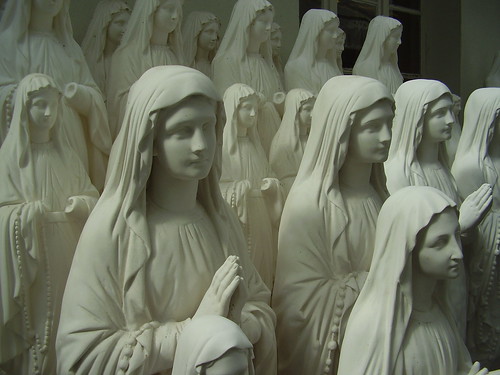
The meaning of artwork was tied to its ritualistic function, its “original use value” (SW 4:256). The cultic value assigned to these works depends on the specificity of the objects. However, technological reproduction calls this value into question. Before, it was always possible to tell the difference between originals and reproductions. Now, technology reaches a point where it is no longer an intelligible distinction. Technology assumes the same role as eternal recurrence. As Eduardo Cadava puts it, “the thought of eternal Return is a thought of technological reproducibility.”
Thought in terms of the eternal recurrence, there is no such thing as an original anything. On a systemic scale, we have no way of knowing what number recurrence we are on. Given the idea of eternal return as mass production, each event is something that has already been produced on previous cycles. In “Little History of Photography”, Benjamin speaks of “the peeling away of the object’s shell, the destruction of the aura, [as] the signature of a perception whose sense for the sameness of things has grown to the point where even the singular, the unique, is divested of its uniqueness – by means of its reproduction” (SW 2:519). Benjamin is discussing the experience of art in the wake of photography. The reproducibility of the photograph forces a change in the way all art is perceived. Even paintings or sculptures are thought of in terms of how they can be reproduced, or are approached as though they are already reproductions. Now, we can apply this perception to eternal recurrence. As a giant process re-production, eternal recurrence divests all things of their uniqueness. Nothing is new, nothing is special. Everything that happens now has already happened and will always happen. In terms of this cycle, the originality of all works crumbles. Even the original “Venus de Milo” is not the original, but rather a recurrent reproduction. There never was an original, because to be is to recur.
In light of this, it is foolish to say that technology kills art. To say that is tantamount to saying that God was alive until the late nineteenth century when Nietzsche killed him. God did not die; Nietzsche merely removed the shroud over his grave to show that he never existed at all. In the same sense, art has always been “dead”. Eternal recurrence already strips everything – not just artworks – of their uniqueness, and has done so since time immemorial. Eduardo Cadava explains it perfectly in Words of Light: “technical reproduction is not an empirical feature of modernity; it is not an invention linked to the so-called modern era. Rather, it is a structural possibility within the work of art.” Technology simply mirrors the process of eternal recurrence: in the same way that that to be is to recur, to be is to be reproducible. That is to say, reproduction does not destroy art. It merely unveils the underlying illusion in the way art is perceived.
The stripping away of the aura is not so much a stripping as it is an unveiling. Benjamin defines the aura as “a strange tissue of space and time: the unique apparition of a distance, however near it may be” (SW 2:518). Elsewhere, Benjamin states that the historical, traditional, ritualistic “aspects of the artwork” can be focused “in the concept of the aura” (SW 3:103). In other words, aura is the veil of authenticity. Authenticity is based in the “here and now of the original” (SW 4:253). It represents “the quintessence of all that is transmissible in it from its origin on, ranging from its physical duration to the historical testimony relating to it” (SW 3:103). Reproduction calls all this into question. “The whole sphere of authenticity eludes technological… reproducibility”, in that it can produce reproductions that are indistinguishable from the original, yet contain none of the traits of transmission or historicity. Rather than saying that reproduction destroys authenticity, it is more correct to say that reproduction shows the fallacy of authenticity.
“In principle, the work of art has always been reproducible”, writes Benjamin in the opening of the first thesis (SW 4:252). Before this time, however, reproductions have always been identifiable, been distinguishable from the original. In fact, Benjamin tells us, authenticity is a byproduct of reproduction technology. It is only when techniques develop to a point where they approach the original that the concept of authenticity emerges. “A medieval picture of the Madonna at the time it was created could not yet be said to be ‘authentic’”, he writes in a footnote to the artwork essay. “It became ‘authentic’ on during the succeeding centuries” (SW 4:271). Authenticity is something that gets applied after the fact, after the act of production. It arises as a response to the encroachment of new technologies onto old concepts of uniqueness. Before, authenticity could retreat to it historical, chemical, and ritualistic basis as a stronghold against the inauthentic forgeries of reproduction. The best hand reproductions and art forgeries still bare a different strain of traceable history than the original, whether it is brushstrokes, chemical composition of the material, or provenance. However, it is now possible to produce items with none of these characteristics. Benjamin’s famous example is of the photographic print. A single negative can produce an innumerable amount of identical prints; “to ask for the ‘authentic’ print makes no sense” (SW 4:256). Technical reproduction expands this beyond merely photographs. It is no longer reasonable to privilege the authentic over any other iteration of the object. Since, as Cadava points out, “the age of technical reproduction includes all of history” , it is possible to understand that this authenticity never made sense. In the realm of recurrence, nothing is authentic; everything has always been reproduced.
the work of art in the age of nihilism
“The Work of Art in the Age of Mechanical Reproduction” may be the extreme form of Benjamin’s nihilism in the economy of his oeuvre. – Rainer Rochlitz, The Disenchantment of Art, 164.
The word “nihilism” does not appear anywhere in the text of “The Work of art in the Age of Its Technical Reproducibility.” Nor is there any mention of Nietzsche. But the effects of both upon the work are very obvious. Benjamin was working on various drafts of the essay from 1935. By this point in time, Nietzsche reaches the height of his infamy in Germany as Hitler’s favorite philosopher. Given that the goal of the work is to create concepts of art that are “completely useless for the purposes of fascism” (SW 4:252), it seems understandable why Benjamin might want to leave these references out. Benjamin did not buy into the fascisization of Nietzsche, as evidenced by heavy usage of Nietzsche quotes in the notes of the same time period. It does seem understandable why Nietzsche does not make an explicit appearance here.
Nonetheless, there is an intensely nihilistic overtone to the work. While contemporary art critics decried the destructive assault on art initiated by technology, Benjamin saw it much differently. Howard Caygill writes:
Benjamin sought not merely recognition of the destructive side, but engaged nihilistically to affirm it as opening possibilities for the future. This was particularly crucial with respect to the work of art, which seemed most threatened by the development of technology. Instead of lamenting the destruction of art by technology, Benjamin sought to affirm a different future for art in the wake of its destruction.
The overriding theme of this essay can be boiled down to the tension between active and passive nihilism. Passive or reactive nihilism denies the destructive element of technology and art. It stands opposed to becoming and tries to hold fast to traditional forms and meanings. Active nihilism on the other hand, affirms the destruction of these forms as a mode of the unfolding of becoming. In terms of recurrence, the destruction of art is never the destruction at all, but rather a point in the chain of cosmic production.
Subscribe to:
Posts (Atom)


