Showing posts with label aura. Show all posts

Thursday, 11 September 2008

the crisis of meaning


The meaning of artwork was tied to its ritualistic function, its “original use value” (SW 4:256). The cultic value assigned to these works depends on the specificity of the objects. However, technological reproduction calls this value into question. Before, it was always possible to tell the difference between originals and reproductions. Now, technology reaches a point where it is no longer an intelligible distinction. Technology assumes the same role as eternal recurrence. As Eduardo Cadava puts it, “the thought of eternal Return is a thought of technological reproducibility.”


Thought in terms of the eternal recurrence, there is no such thing as an original anything. On a systemic scale, we have no way of knowing what number recurrence we are on. Given the idea of eternal return as mass production, each event is something that has already been produced on previous cycles. In “Little History of Photography”, Benjamin speaks of “the peeling away of the object’s shell, the destruction of the aura, [as] the signature of a perception whose sense for the sameness of things has grown to the point where even the singular, the unique, is divested of its uniqueness – by means of its reproduction” (SW 2:519). Benjamin is discussing the experience of art in the wake of photography. The reproducibility of the photograph forces a change in the way all art is perceived. Even paintings or sculptures are thought of in terms of how they can be reproduced, or are approached as though they are already reproductions. Now, we can apply this perception to eternal recurrence. As a giant process re-production, eternal recurrence divests all things of their uniqueness. Nothing is new, nothing is special. Everything that happens now has already happened and will always happen. In terms of this cycle, the originality of all works crumbles. Even the original “Venus de Milo” is not the original, but rather a recurrent reproduction. There never was an original, because to be is to recur.

In light of this, it is foolish to say that technology kills art. To say that is tantamount to saying that God was alive until the late nineteenth century when Nietzsche killed him. God did not die; Nietzsche merely removed the shroud over his grave to show that he never existed at all. In the same sense, art has always been “dead”. Eternal recurrence already strips everything – not just artworks – of their uniqueness, and has done so since time immemorial. Eduardo Cadava explains it perfectly in Words of Light: “technical reproduction is not an empirical feature of modernity; it is not an invention linked to the so-called modern era. Rather, it is a structural possibility within the work of art.” Technology simply mirrors the process of eternal recurrence: in the same way that that to be is to recur, to be is to be reproducible. That is to say, reproduction does not destroy art. It merely unveils the underlying illusion in the way art is perceived.

The stripping away of the aura is not so much a stripping as it is an unveiling. Benjamin defines the aura as “a strange tissue of space and time: the unique apparition of a distance, however near it may be” (SW 2:518). Elsewhere, Benjamin states that the historical, traditional, ritualistic “aspects of the artwork” can be focused “in the concept of the aura” (SW 3:103). In other words, aura is the veil of authenticity. Authenticity is based in the “here and now of the original” (SW 4:253). It represents “the quintessence of all that is transmissible in it from its origin on, ranging from its physical duration to the historical testimony relating to it” (SW 3:103). Reproduction calls all this into question. “The whole sphere of authenticity eludes technological… reproducibility”, in that it can produce reproductions that are indistinguishable from the original, yet contain none of the traits of transmission or historicity. Rather than saying that reproduction destroys authenticity, it is more correct to say that reproduction shows the fallacy of authenticity.

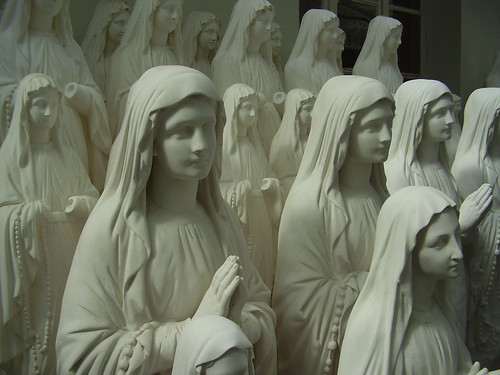
“In principle, the work of art has always been reproducible”, writes Benjamin in the opening of the first thesis (SW 4:252). Before this time, however, reproductions have always been identifiable, been distinguishable from the original. In fact, Benjamin tells us, authenticity is a byproduct of reproduction technology. It is only when techniques develop to a point where they approach the original that the concept of authenticity emerges. “A medieval picture of the Madonna at the time it was created could not yet be said to be ‘authentic’”, he writes in a footnote to the artwork essay. “It became ‘authentic’ on during the succeeding centuries” (SW 4:271). Authenticity is something that gets applied after the fact, after the act of production. It arises as a response to the encroachment of new technologies onto old concepts of uniqueness. Before, authenticity could retreat to it historical, chemical, and ritualistic basis as a stronghold against the inauthentic forgeries of reproduction. The best hand reproductions and art forgeries still bare a different strain of traceable history than the original, whether it is brushstrokes, chemical composition of the material, or provenance. However, it is now possible to produce items with none of these characteristics. Benjamin’s famous example is of the photographic print. A single negative can produce an innumerable amount of identical prints; “to ask for the ‘authentic’ print makes no sense” (SW 4:256). Technical reproduction expands this beyond merely photographs. It is no longer reasonable to privilege the authentic over any other iteration of the object. Since, as Cadava points out, “the age of technical reproduction includes all of history” , it is possible to understand that this authenticity never made sense. In the realm of recurrence, nothing is authentic; everything has always been reproduced.

Without authenticity, without aura, art no longer as a source of value. The basis of its meaning has always depended on its uniqueness. Benjamin attributes “l’art pour l’art” as a reaction to this crisis, a “theology of art” (SW 4:256). However, this reaction is the wrong way of looking at the crisis. The loss of meaning, authenticity and aura, the loss of the traditional values of aesthetics are only is only seen as a crisis from a perspective where these things are still relevant. Authenticity does not exist, and its absence from modern life is by no means an indication of nor a cause for decline. “It is by means of fiction that one falsifies and depreciates” , says Deleuze in Nietzsche & Philosophy. This crisis of meaning is similar to the crisis brought about by nihilism which Nietzsche outlines in The Will to Power. The old ways of evaluating are called into crisis and exposed as fallacies. As a consequence, “the categories ‘aim’, ‘unity’, ‘being’ which we used to project some value into the world – we pull out again; so the world looks valueless” (WP §12a). This valuelessness is not a problem for Nietzsche, for “once we have devaluated these three categories, the demonstration that they cannot be applied to the universe is no longer any reason for devaluating the universe” (WP §12b). There is no such thing as higher values for Nietzsche. This is part of what a nihilistic reading of “The Work of Art…” entails. We misinterpret Benjamin if we see the decline of the aura or the decline of the artist as a negative, lamentable event. For example, Rochlitz chastises Benjamin, saying, “[he] no longer even asks about the aesthetic qualities of works of art.” But these qualities are based on the old categories. The problem of their absence from art it is not a problem in the wake of technical reproducibility, which shows them to have never been valid categories at all. The necessity of certain values becomes unfathomable in a world free of that mode of valuation. This is why Benjamin privileges film and photography, as they represent an acceleration of the tendency. They are artworks solely made for the purpose reproduction. That is to say, to produce is to participate in reproduction. Benjamin hopes that through shattering the wall of authenticity and aura, he can help “[emancipate] the work of art from its parasitic dependence on ritual” (SW 4:256).

the work of art in the age of nihilism

“The Work of Art in the Age of Mechanical Reproduction” may be the extreme form of Benjamin’s nihilism in the economy of his oeuvre. – Rainer Rochlitz, The Disenchantment of Art, 164.

The word “nihilism” does not appear anywhere in the text of “The Work of art in the Age of Its Technical Reproducibility.” Nor is there any mention of Nietzsche. But the effects of both upon the work are very obvious. Benjamin was working on various drafts of the essay from 1935. By this point in time, Nietzsche reaches the height of his infamy in Germany as Hitler’s favorite philosopher. Given that the goal of the work is to create concepts of art that are “completely useless for the purposes of fascism” (SW 4:252), it seems understandable why Benjamin might want to leave these references out. Benjamin did not buy into the fascisization of Nietzsche, as evidenced by heavy usage of Nietzsche quotes in the notes of the same time period. It does seem understandable why Nietzsche does not make an explicit appearance here.

Nonetheless, there is an intensely nihilistic overtone to the work. While contemporary art critics decried the destructive assault on art initiated by technology, Benjamin saw it much differently. Howard Caygill writes:

Benjamin sought not merely recognition of the destructive side, but engaged nihilistically to affirm it as opening possibilities for the future. This was particularly crucial with respect to the work of art, which seemed most threatened by the development of technology. Instead of lamenting the destruction of art by technology, Benjamin sought to affirm a different future for art in the wake of its destruction.

The overriding theme of this essay can be boiled down to the tension between active and passive nihilism. Passive or reactive nihilism denies the destructive element of technology and art. It stands opposed to becoming and tries to hold fast to traditional forms and meanings. Active nihilism on the other hand, affirms the destruction of these forms as a mode of the unfolding of becoming. In terms of recurrence, the destruction of art is never the destruction at all, but rather a point in the chain of cosmic production.

The so-called destruction of art is the reaction to the new forms of art that begin to emerge as a result of technology, namely film and photography. As well, reproduction technology has developed to a point where the reproduction of old artworks “profoundly modifies their effect” (SW 4:253). Benjamin feels that is traditional effect of art is tied “unique existence in a particular space … that bears the mark of the history to which the work has been subject” (SW 4:253). This is mark is what Benjamin terms the “aura”. This aura finds its power in ritual. The earliest forms of art were linked ritual, “and it is highly significant that the artwork’s auratic mode of existence is never entirely severed from is ritual function” (SW 4:256). Ritual, be it magical or religious, is based on the uniqueness of the items worshiped. Uniqueness is what differentiates a table knife from a sacrificial dagger, an ordinary wine glass from a communion chalice. The same applies to artworks. The uniqueness of the painting led to the “cult of beauty”. Given that traditional art theory is based on singularity, the whole system is called into question with the introduction of new techniques of reproduction. The problem arises in that reproduction technology has advanced to such a degree that artworks can no longer lay claim to uniqueness.There are two possible responses for this crisis, one of which is passive, reactive nihilism. This entails denying the changes of art, holding on to old forms, and evaluating new emergences via the old criteria. An example of this would be questioning whether or not photography is art. As we will see later, Benjamin shows that there is a high price to pay for this. The other alternative is the acceptance of change, the embracing of new forms, and the creation of new criteria. This is only achievable via the affirmation of the crisis as such, which is to say, via the nihilistic affirmation.